The Wave, or Why to Publish (corrected and expanded)

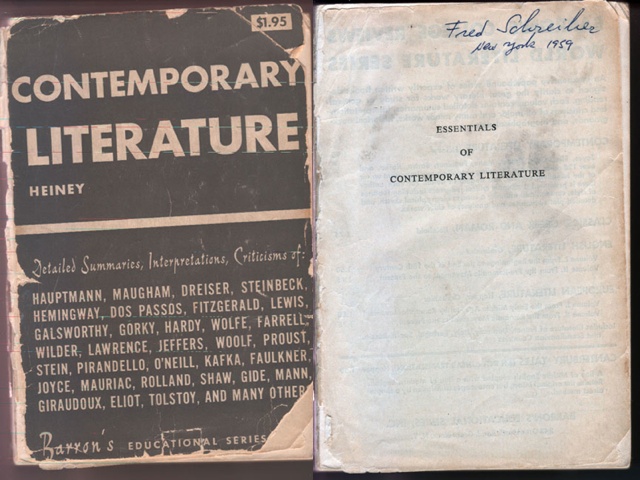
Contemporary Literature cover and frontispiece
Fred Schreiber's copy of Contemporary Literature, 1956

My father was a skilled and productive writer. He published many novels, including the recently reissued National Book Award nominee The Balloonist. There were a few non-fiction books as well: some early scholarly work about Italian literature, a book about solo sailing around the world, and a series of literature study guides for students with the usual plot summaries, discussion of themes etc. The crib books were the least important thing he had done, and my mother had done a lot of the work with him grinding out summaries.

Now, a leap. In the early 1990s I was an America Online user and an avid player of online trivia. Online social networks were very new, and this was a great one. Intelligent, educated obsessives battled for free online hours at a time when connection time was expensive. I made some good friends among the “Triviots” and not too many enemies, and some of these people are close friends to this day.

One day in chat I talked about my father and his work. Later I received an email from a fellow Triviot: Are you really this guy’s son? He changed my entire life around! We have to talk.

The email was from Fred Schreiber, an antiquarian bookseller in New York and a former professor of Classics.

And now, a lesson. The three paragraphs below are completely incorrect, which is why they’re in strikeout. I am not sure how this happened, but a story appeared in my mind — backed up by memories of conversations that did not occur — that is in fact not true. The story is told in the link below, and is very different: a working-class kid and compulsive reader, a love for books, and a formal education that started a mile behind and finished to win.

My Life With Books: How One Thing Leads to Another

After gently correcting my bizarrely fictional account, he was kind enough to say:

“The fact remains that your father’s book played a VERY BIG part in my early education; the proof is that I have kept it for well over a half century.”

So there we are, with a new story. At this point I really have no idea what part my father’s little book had, and I’m going to back slowly away from the story and just say that Fred’s pretty amazing. For my own part, I seem to have fallen into one of my father’s novels, possibly Hemingway’s Suitcase, in which the line between fact and literature becomes thicker and thicker as imagination and fraud switch places.

I apologize to Fred for inadvertently romanticizing him into a kind of high culture Horatio Alger character. The true story is better and more complicated than accidental fiction, as lives usually are.

Fred’s story did not begin in academia. In 1956, he was uninterested in school or anything else in the straight world. By his account, he was a tough guy headed for a working class life at best, and constantly in some kind of trouble. Some twist of fate, probably a court order, put him in night high school at the age of 21, taking bonehead classes and hating it.

For his sweathog English class, Fred picked up a copy of Contemporary Literature, one of my father’s crib books, with plot summaries and critical paragraphs to get him through this nightmare with the minimum of actual reading. And then something odd happened.

He became fascinated with the stories, the ideas, and the writers. In a recent email to me, he put it this way: “I remember how fascinating and instructive I found the book: your father had a way of telling the essential facts about an author in a most readable and elegant way.” I have to drag out a cliché here: a door opened for him into an entirely new world, full of stories and characters and ideas, the last thing he’d expected from an enforced trip back to high school.

The transformation took Fred from the streets of New York to college, graduate school, a Ph.D. in Classical Philology from Harvard, and a professorship at CUNY in Classics. He was as immersed in literature and ideas as a person could be, and loving it. When he got tenure and a job for life, though, he was immediately bored. He left academia and began dealing in old books. To this day he and his partner wife are E.K. Schreiber, dealer in books before 1700.

So this is the story of how a young person headed for a tough life in a hard city became a seller of “Early Printed Books, Incunabula, Renaissance Humanism, Early and Important Editions of the Greek & Latin Classics, Early Illustrated Books, Emblem Books, Theology, Early Bibles (in Greek & Latin).” And my father’s books were the key to that world. Not any of the award-winning novels, or the studies of Italian post-war literature, but the plot summary study aids he bought for $1.95 so he wouldn’t have to read his assigned work in remedial adult high school.

Publish! Record! Blog, even! Don’t just create, distribute, as far and wide as you can. To this day my father’s mostly out-of-print books are in libraries and used bookstores all over the world, in many languages. I have no idea if there’s just one Fred story there, or a thousand. If you have something to say or make, please put some effort into sharing it.

A bit of yourself, thrown far enough, hits the ocean and makes a little wave. You may never see the shore on the other end, never see the size as it breaks, but make the wave anyway.

The devil’s in the details

In the news today, an 800-year-old Easter Egg: Giotto sneaked the Devil into a painting of St. Francis of Assissi. They speculate that he was annoyed with someone. Took some guts to do that, too. Disney may get very angry at little jokes in their movies but they haven’t yet burned someone at the stake for it.

See the full story from the International Business Times, who has the best big picture.

Detail below shows Mr. Beelzebub.

The Devil Himself
Detail from Giotto's St. Francis fresco

There are certain things that enter the minds of people even without one.

The andies

Five years ago I revealed that an unknown number of public figures were created as clones of the late great absurdist comedian Andy Kaufman. That article is linked here: Theory: We Are All Andy Now.

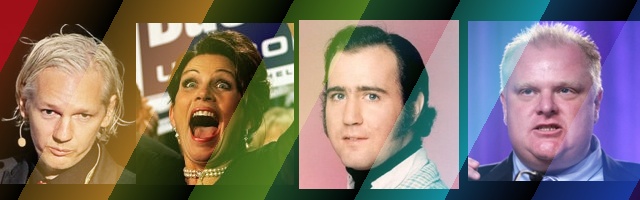
This was a tremendous breakthrough. Without this knowledge, we would have been powerless against an army of Andys. It’s been difficult to get by even knowing that characters like Sarah Palin, Rob Ford, Fred Phelps, Julian Assange, and Keith Olbermann are clones of a legendary avant-garde prankster. The current Republican Party candidates for the U.S. Presidency are a clean sweep of 100% Andys. If we didn’t know that, our whole world would be a joke. I mean, think about it.

Two things came up this week that shed further darkness on the situation. I mentioned Steve Rocco, a local political character here, as an Andy. Since I hadn’t done enough research, I didn’t realize that the person commenting at the time about Andy’s death being faked was… Rocco himself. Not only is he an Andy, but his shtick encompasses “Andy Death Denier” along with Mafia paranoia, sunglasses and hat combo, and alleged ketchup theft. So this is a recursive Andy, a meta-Andy, or, scariest of all, a self-aware Andy clone.

Which leads to the next problem. Clearly there are both male and female Andys, and some of them have produced children. Has anyone considered the potential impact of a generation of half-Andys? And if two Andys mate, what happens then?

There’s been talk about a limit to the absurd. Could we have reached the state in human civilization where that combination of meaningless narcissism, absurd behavior, and destructive charisma has peaked? I think not. The second generation Andys are coming. Like the physicists of the 19th century, we are about to be jolted into a new age of Quantum Andys, in which the overwhelming confusion and horror of public life turns us all into Andy, one by one.

I’ve known all my life that Eugene Ionèsco was right about our world. And Rhinoceros has enough parallels with the last decade here already. But I had no idea we were all to be Andy. Who will be the last to go?

PURCHASE MY AMATEURISH CRAP RIGHT THIS INSTANT

I have had a Zazzle Store for quite a while and never really promoted it, but I have a total of TWO products.

1. The “Bob is Love” U.S. postal stamps, in a variety of denominations, featuring a touching and artistical black & white photo of Mr. Bob Trout, my best friend and an icon of the greater Newport-Mesa area:


2. The tiresome “nerd freedom” Software is Speech shirt, featuring said slogan on the front and what I am pretty sure is the First Amendment to the Constitution of the United States of America in binary on the back. You see, it’s cool because it’s nerdy and also because you can stand up for an abstract idea of freedom without any risk simply by purchasing an inexpensive consumer item:

The back of the shirt


Go buy lots of both now.

Hollywood Elegies, by Bertolt Brecht

I first heard these set to Hans Eisler’s music, as sung by Dagmar Krause on her wonderful record Supply and Demand. My favorite is the last one, “The Swamp”. It hits as hard as it did in the forties.

I
The village of Hollywood was planned according to the notion
People in these parts have of heaven. In these parts
They have come to the conclusion that God
Requiring a heaven and a hell, didn’t need to
Plan two establishments but
Just the one: heaven. It
Serves the unprosperous, unsuccessful
As hell.

II

By the sea stand the oil derricks. Up the canyons
The gold prospectors’ bones lie bleaching. Their sons
Built the dream factories of Hollywood.
The four cities
Are filled with the oily smell
Of films.

III
The city is named after the angels
And you meet angels on every hand
They smell of oil and wear golden pessaries
And, with blue rings round their eyes
Feed the writers in their swimming pools every morning.

IV
Beneath the green pepper trees
The musicians play the whore, two by two
With the writers. Bach
Has written a Strumpet Voluntary. Dante wriggles
His shrivelled bottom.

V
The angels of Los Angeles
Are tired out with smiling. Desperately
Behind the fruit stalls of an evening
They buy little bottles
Containing sex odours.

VI
Above the four cities the fighter planes
Of the Defense Department circle at a great height
So that the stink of greed and poverty
Shall not reach them

THE SWAMP

I saw many friends, and among them the friend I loved most
Helplessly sink into the swamp
I pass by daily.

And a drowning was not over
In a single morning. Often it took
Weeks; this made it more terrible.
And the memory of our long talks together
About the swamp, that already
Had claimed so many.

Helpless I watched him, leaning back
Covered with leeches
In the shimmering
Softly moving slime:
Upon the sinking face
The ghastly
Blissful smile.

Bob speaks: The collection call.

I got one of those calls. A young kid said “Sir, if you are unwilling to pay the amount owed, you’ll have to talk to Mr. James.”

“Listen to me for a second, kid. You work for Mr. James, and he drives a Porsche, and you want to park your Toyota Tacoma next to his Porsche, and you’re an office boy with aspirations, and you believe that this is how it works. I don’t think you understand.

“I have worked at an establishment similar to yours. I was a skip tracer, you probably know the phrase.  A skip tracer is an alcoholic murderer who has done hard time, and learned hard things during the hard time. Someone who really does not give a shit. I think you understand.

“And I will find you, because that is what skip tracers do, and I will be waiting in the parking lot with a baseball bat to smash the windows out of your fucking Toyota Tacoma and then smash your fucking skull in and smash Mr. James’ face in as well, if you ever fucking call me again. I think you understand.”

There were no more calls.

The 99% gets one more pissed-off Marine

Manifestos from the Anonymous crowd are usually puerile and pointless. Coming from a Marine vet who lives in the real world, this one is neither.

“I am a United States Marine Corps combat veteran. I am a proud American and a patriot. I love my country, democracy and the vision our founding fathers had for this great nation.

“I went to war for my country. I saw and did ugly things that would make the average American civilian run in fear. I saw teenage boys die in the name of my country. I saw other teenage boys turned into hardened killers, left to return home unable to cope with the acts they were required to commit out of love for their country. I’ve seen several of these young men take their own lives upon returning home from the endless wars they have been subjected to.

“I’ve seen thousands of civilians die.

“In the eight years I have been home from the war, I’ve struggled to find the vital national interest I was sent to protect. I haven’t found any, all I’ve found is corruption and corporate profiteering, sw​eetheart backroom deals and hushed civilian casualty numbers.

“I see an elite class characterized by extreme wealth exerting undue influence over my government and enslaving my people through corrupt means. I see them eating away the rights I gladly fought to protect. I will just as enthusiastically fight to protect those rights again.

“I took an oath to uphold and defend the Constitution of the United States against all enemies, foreign and domestic. I take this oath seriously.

“You may not be a member of the United States Armed Forces. You may not be a combat veteran. You may have never left your home town. Whoever you are, if you are a patriot and a proud American the time for courage and action has come. Do not disgrace the legacy of our great nation by sitting idly by while our future is squandered for the benefit of the elite.

“Put down your video games and turn off your TV. Educate yourself about your government, our economy and the actions which have been taken in your name over the past few decades. Get involved.”

All that is necessary for the triumph of evil is that good men do nothing. —Edmund Burke

“I am a United States Marine.

“I am a combat veteran.

“I am a proud American.

“I am a patriot.

“I am the 99%.

“I am Anonymous.

“We are Legion.

“We do not forgive.

“We do not forget.

“Expect us.”

Something is afoot at the gas station.

The gas station routine has not changed in years. I put in my card, enter my zip code, choose my fuel, and pump. When I’m done I put the spout back in its bracket and the machine asks me if I want a receipt. I say yes, it spits out the receipt, and I leave. Sometimes I remember to close the gas cap again.

About half the gas stations changed recently. The machine now asks the receipt question before I can pump. At the end, it gratuitously announces that ‘THE OPERATION COMPLETED SUCCESSFULLY” and out comes the receipt.

Can you see what’s wrong with this?

If I don’t make the receipt decision until the end, I’m looking right at the gallons and dollars when the receipt pops out, and without conscious decision I compare them. By the time it hands out the receipt the numbers are all done, and it doesn’t know until then that I requested paper proof of its honesty.

But now the machine knows from the beginning whether I’ve asked for a receipt. If I say no, the computer can cheat me and give me less gallons or charge me more, knowing that I’ll have nothing to immediately compare with and no paper later when small differences in my credit card show up or the car runs out of gas sooner than expected.

Considering the heavy presence of organized crime in gasoline fraud around here (particularly in PIN thefts from debit-only stations), one has to wonder, doesn’t one?